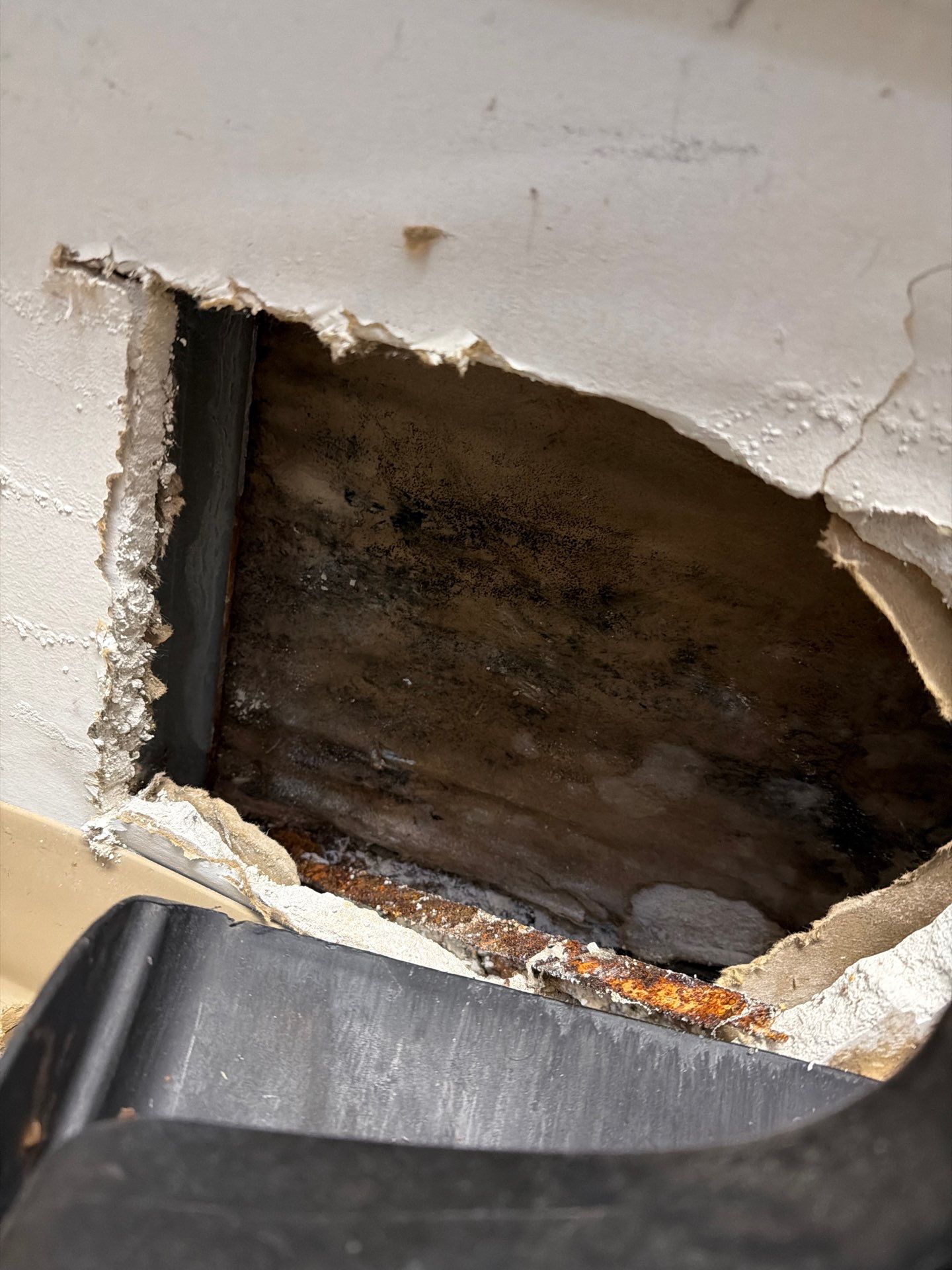
Why Attic Leaks Behave Differently Than Other Water Damage
Most water damage moves downward and stops when it hits a hard surface. Attic water damage works against you in three specific ways. First, the water enters from above and saturates absorbent materials like blown-in cellulose or fiberglass batts, which hold moisture against your ceiling joists for weeks. Second, attics in Williams Creek swing between 40 degrees in February and 130 degrees in July, creating the exact humidity cycle that mold spores need to colonize. Third, the leak source is often nowhere near the visible stain because water travels along rafters, trusses, and the underside of decking before it finally drips through a seam in the drywall.
That is why a stain in your hallway might trace back to a popped nail at the ridge or a failed pipe boot on the opposite side of the roof. Before any drying begins, we map the actual path with moisture meters and thermal imaging. If you skip that step, you dry the symptom and miss the source. Six weeks later the stain comes back, and now you have a real mold problem rather than a contained one. For homeowners weighing whether this falls under storm policy or maintenance, our notes on storm damage restoration walk through how wind-driven rain and hail claims are typically documented.
The Common Roof Failure Points Williams Creek Water Restoration Sees Most Often
Across Williams Creek attic jobs, a small set of failure points produces the majority of leaks. Pipe boots are the leader. The rubber gasket around plumbing vents typically lasts 10 to 14 years, and once it cracks, every rainfall sends a slow trickle down the pipe and into the insulation directly below. Step flashing along chimneys and dormers ranks second, especially on homes where a re-roof was done without replacing the flashing. Ridge vents and ridge caps come third, particularly after high-wind events that lift fasteners just enough to break the seal but not enough to be visible from the ground.
Less obvious culprits include nail pops from thermal cycling, ice damming at eaves on homes with poor attic ventilation, and condensation buildup mistaken for an active leak. That last one matters because the fix is ventilation work, not roofing work, and a misdiagnosis means you replace shingles that were never the problem.
The Attic Water Damage Comparison You Actually Need
The table below is the one we use internally when scoping a job. It assumes a standard 1,500 to 2,500 square foot Williams Creek home with asphalt shingles, vented soffits, and either blown-in or batt insulation. Costs reflect typical Williams Creek market ranges as of recent project work, not national averages.
| Damage Level | Visible Signs | IICRC Category | Hidden Risks | Typical Restoration Steps | Williams Creek Cost Range | Timeline |
|---|---|---|---|---|---|---|
| Level 1: Minor Active Leak | Small ceiling spot under 12 inches, damp insulation in one bay, no sagging | Category 1 (clean rainwater, under 24 hours) | Insulation R-value loss, nail rust on decking | Source repair, spot insulation removal, targeted drying with one air mover and dehumidifier, moisture verification | $800 to $1,800 | 2 to 4 days |
| Level 2: Sustained Leak | Multiple stains, sagging drywall, matted insulation across several joist bays, musty odor | Category 1 transitioning to Category 2 (24 to 72 hours) | Drywall failure, early mold growth on rafters, compromised insulation across 40 to 100 sq ft | Tarping if active, insulation removal in affected sections, antimicrobial application, drying with multiple air movers and commercial dehumidifier, drywall replacement | $2,400 to $6,500 | 5 to 9 days |
| Level 3: Long-Term Hidden Leak | Stained, soft, or warped decking visible from below, mold staining on rafters, sagging ceiling, possible electrical concerns at can lights | Category 2 (over 72 hours, microbial growth present) | Structural rot in rafters or trusses, mold colonies in insulation, contaminated HVAC if ductwork runs through attic | Containment, full insulation removal, HEPA air scrubbing, antimicrobial treatment, partial decking or rafter replacement, drywall removal and replacement, HVAC cleaning if affected | $6,000 to $14,000 | 10 to 18 days |
| Level 4: Storm or Catastrophic Loss | Visible daylight through decking, collapsed sections of ceiling, soaked HVAC equipment, standing water on vapor barrier | Category 2 or 3 depending on contamination | Full structural compromise, total insulation loss, potential roof deck replacement, possible Category 3 if sewage stack or rodent contamination involved | Emergency board-up, complete attic strip-out, structural drying, decking and framing repair, full reinsulation, ceiling rebuild, coordination with roofer and insurance adjuster | $14,000 to $40,000+ | 3 to 6 weeks |
What the Table Tells You About Your Next Move
The single most expensive mistake homeowners make is treating a Level 2 leak like a Level 1. A small ceiling stain looks identical whether the water sat for 18 hours or 18 days, and the difference between those two scenarios is roughly five thousand dollars. That is why thermal imaging and moisture mapping are not upsells, they are diagnostic baselines. Any restoration company that quotes you a price before measuring moisture content in the decking and insulation is guessing.
Insurance behavior also shifts by level. Sudden and accidental events, like a wind-lifted shingle during a Williams Creek thunderstorm, are usually covered. Long-term seepage from a worn pipe boot or ice damming that recurred over multiple winters is often excluded as maintenance. Document the date you first noticed the stain, photograph everything before cleanup begins, and request a written scope from your restoration contractor that uses IICRC S500 language. If mold has already begun colonizing, our breakdown of mold after water damage explains how remediation gets bundled into the claim, and how the broader water damage restoration scope ties roof, attic, and ceiling work together so you are not paying three contractors to do overlapping jobs.
One last point on timing. Attic temperatures accelerate everything. A leak that would take 72 hours to grow mold in a basement can hit visible colonization in 36 hours during a humid Williams Creek July. If you see a fresh stain, you are on a clock measured in hours, not days. Calling Williams Creek Water Restoration the same day you spot discoloration almost always keeps the job at Level 1 or 2 pricing, while waiting a long weekend can push the same loss into Level 3 territory with mold protocols, containment, and a far longer displacement from the affected rooms.