The 5-Minute Triage Checklist
Run this before you call anyone. It tells you what you are dealing with.
- Identify the water source (clean supply line, appliance, sewage, storm)
- Note how long the water has been sitting (under 24 hours is your best window)
- Check for cupping (edges raised), crowning (center raised), or buckling (lifting off subfloor)
- Press a fingernail into a wet board. Soft? Bad sign.
- Lift a floor vent or transition strip and look at the subfloor underneath
The 7 Factors That Decide Save vs. Replace
We grade every Williams Creek hardwood job against these. You can too.
- Water category. Category 1 (clean) is savable. Category 2 (gray, dishwasher, washer overflow) is sometimes savable. Category 3 (sewage, flood, toilet backflow) almost always means replacement of porous flooring.
- Dwell time. Under 24 hours, dry-in-place has a real shot. 24 to 72 hours, partial salvage. Over 72 hours, expect tear-out of affected boards plus subfloor checks.
- Floor type. Solid hardwood handles drying better than engineered. Engineered plank with HDF core often delaminates and cannot be refinished.
- Subfloor material. Plywood dries. OSB swells and crumbles. Concrete slab dries slowly but does not warp.
- Finish age and condition. A newer polyurethane finish slows absorption. Worn finish lets water sink fast.
- Moisture readings. Pin meters above 16% MC in wood means active damage. Above 20% means trapped moisture you cannot see.
- Mold indicators. Musty smell, dark staining at seams, or visible growth on the subfloor changes the math completely.
What to Say to Your Insurance Adjuster
Language matters. Use these terms.
- "Sudden and accidental discharge" (most policies cover this)
- "Category of water loss" (ask them to note it)
- "Moisture mapping documentation"
- "Like kind and quality replacement"
- "Matching adjacent flooring" (critical if only part of the floor is damaged)
- "IICRC S500 compliant drying"
- "Secondary damage mitigation" (covers walls, baseboards, insulation)
Photograph everything before you move a single board. Save wet baseboards in a garbage bag as evidence. Get moisture readings in writing. Ask the adjuster for the claim number in your first conversation and request that all communication go through email so you have a paper trail.
Wood Species and How They React
Not every hardwood responds the same way to water. Williams Creek Water Restoration sees these patterns across Williams Creek homes.
- Red and white oak: the most forgiving. Tight grain, holds shape, refinishes beautifully after drying.
- Maple: dense but prone to dramatic cupping. Slow, controlled drying is non-negotiable.
- Hickory: hard and stable, but the grain pattern hides damage until it is severe.
- Brazilian cherry and other exotics: high tannin content stains fast. Color matching after partial replacement is brutal.
- Pine and softwoods: absorb water quickly, dent under drying mats, often need replacement.
- Engineered with plywood core: sometimes salvageable if the top veneer is intact.
- Engineered with HDF or MDF core: usually a total loss once saturated.
Questions to Ask Any Contractor Before You Sign
- Are you IICRC certified in water damage restoration?
- Will you provide daily moisture logs?
- What is your target MC and how will you verify it?
- Do you bill insurance directly or do I pay and submit?
- Who handles the refinish or replacement phase after drying?
- What is your guarantee if the floor fails inspection after drying?
Williams Creek Water Restoration answers all of these in writing before the first piece of equipment hits your floor. If a contractor will not put their drying plan on paper in Williams Creek, that is your signal to keep calling.
If the water originated below grade, the foundation matters as much as the floor. Our basement flooding response page covers what happens when the source is downstairs.
When Replacement Is the Honest Answer
- Sewage or Category 3 water touched the floor
- Water sat untreated for more than 72 hours
- Subfloor is OSB and has swelled more than 1/8 inch
- Engineered plank shows delamination at the core
- Mold growth on the underside of planks
- Floor was already nearing end of life (3+ refinishes deep)
- Adhesive-set planks over slab where the glue line has failed
- Wide-plank floors over 5 inches that have cupped past 1/16 inch
Realistic Cost Ranges in Williams Creek
Numbers vary by square footage, water category, and access. These are honest ballparks.
- Emergency extraction and setup: $500 to $1,500
- Dry-in-place hardwood (per room): $1,200 to $3,500
- Refinishing after successful drying: $3 to $8 per square foot
- Partial board replacement and weave-in: $8 to $15 per square foot
- Full tear-out and replacement with subfloor repair: $12 to $25 per square foot
- Engineered plank replacement (cannot refinish): $9 to $18 per square foot
- Mold remediation if discovered under planks: $1,500 to $6,000 depending on square footage
- Subfloor replacement (plywood or OSB): $2 to $5 per square foot on top of flooring costs
If your damage came from a burst supply line, our burst pipe water damage cost breakdown walks through how those numbers stack with drywall, cabinets, and contents.
Visual Damage Signs and What Each Means
- Cupping: edges higher than center. Often reversible with controlled drying.
- Crowning: center higher than edges. Usually means someone sanded cupped wood before it dried fully. Replace.
- Buckling: planks separating from subfloor. Replace those sections.
- Black staining: tannin reaction or mold. Test before assuming.
- Gaps between planks: over-drying or shrinkage. Sometimes cosmetic only.
- Squeaks that were not there before: subfloor fasteners lost grip. Inspect from below if possible.
- Finish blushing or whitening: moisture trapped under the polyurethane. Refinish-only fix if the wood below is sound.
- Lifting nail heads: the wood swelled around the fastener and pushed back. Check surrounding boards for movement.
The Drying Process We Use on Savable Floors
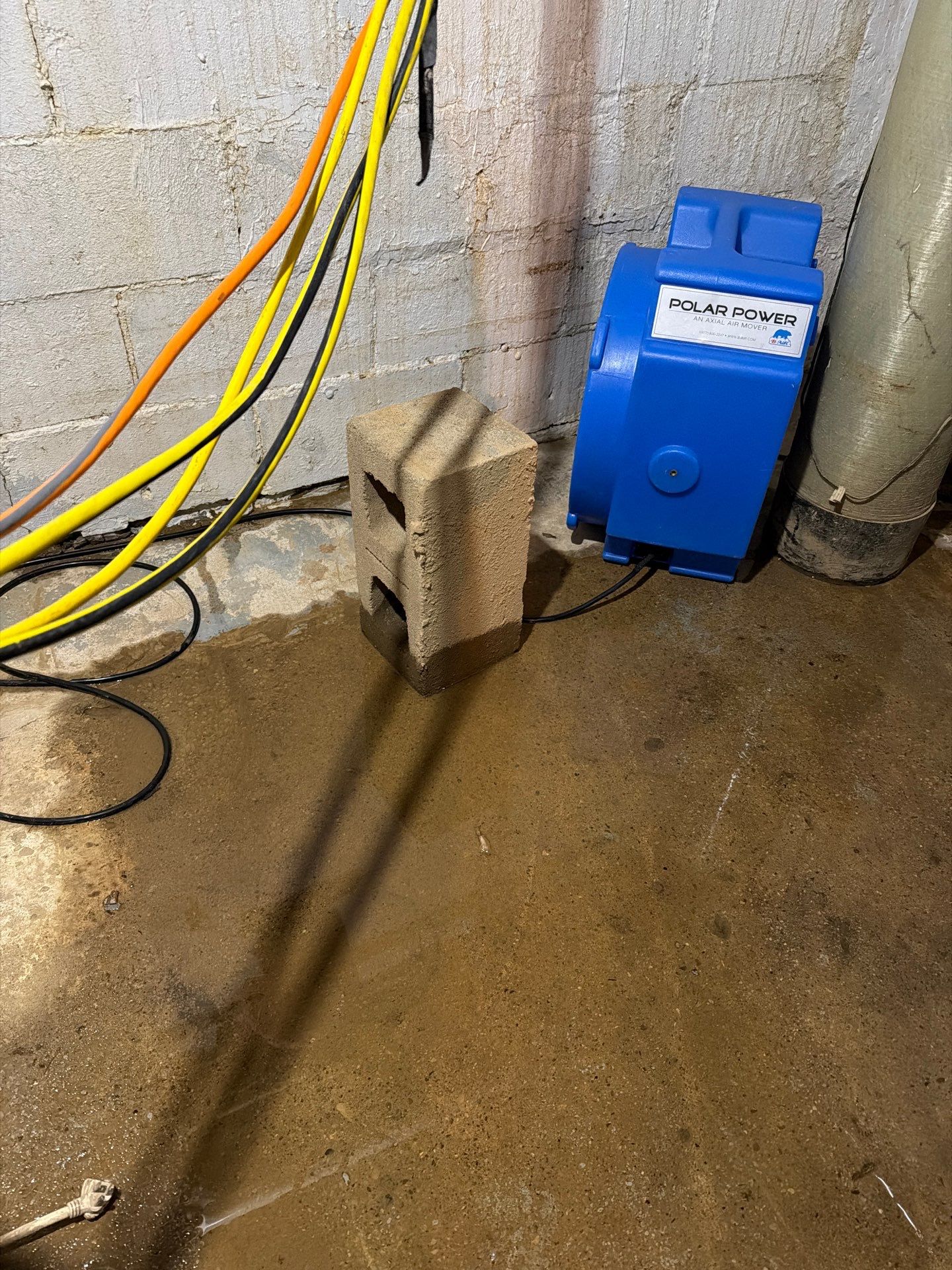
When the floor is a candidate for rescue, here is what professional drying actually looks like in a Williams Creek home. This is the same protocol we use during full water damage restoration jobs.
- Extract surface water with weighted rover extractors
- Pull baseboards and drill small relief holes in tongue-and-groove seams if needed
- Set hardwood-specific drying mats that pull moisture from below the finish
- Deploy LGR dehumidifiers sized to the cubic footage
- Monitor moisture content daily with pin and pinless meters
- Target 8 to 12% MC depending on regional equilibrium
- Document readings for your insurance adjuster
Typical dry time runs 3 to 7 days. Anyone telling you 24 hours on hardwood is selling you a fairy tale.
Mistakes That Turn Savable Floors Into Replacements
- Running box fans without dehumidification (drives moisture into walls)
- Sanding cupped boards before they fully dry
- Replacing baseboards before subfloor is verified dry
- Skipping the basement or crawlspace check below the affected room
- Waiting on insurance approval before starting mitigation (most policies require prompt action)
- Cranking the heat to 90 degrees thinking it speeds drying (it warps boards faster)
- Covering wet wood with plastic sheeting and trapping vapor
- Walking heavy traffic across saturated planks before extraction
When You Can Almost Always Save It
- Clean water from a supply line caught within 12 hours
- Solid 3/4 inch hardwood over plywood subfloor
- Cupping only, no buckling
- Moisture readings under 20% at first inspection
- No prior water history in that area
- Baseboards still tight and finish still intact at the seams